Healthcare Technology in Practice — Part 1
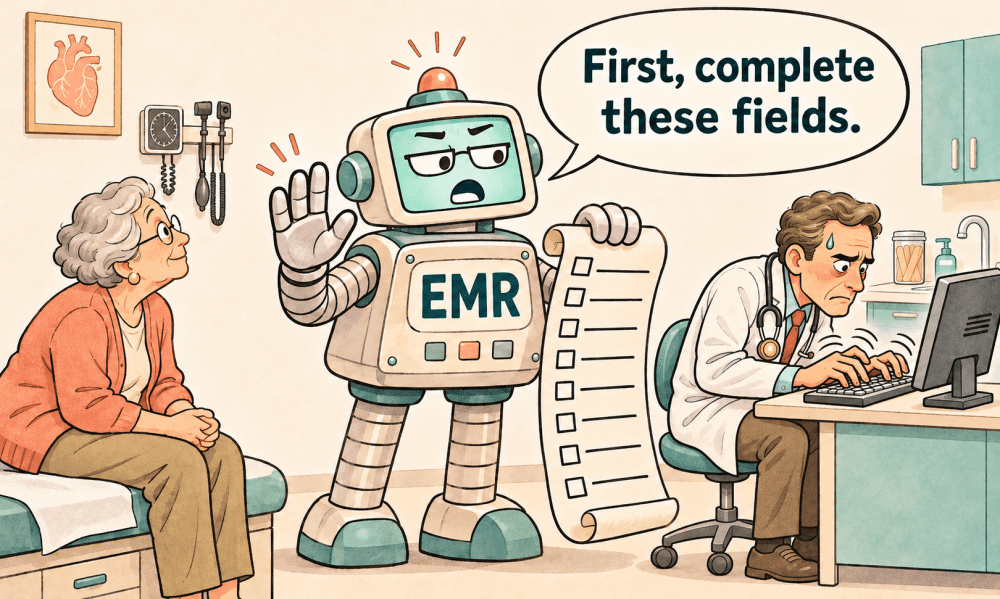
If you remember a doctor pulling up a chair, opening a paper chart, and looking at you while you talked, you may wonder how a computer became such a large part of the visit. For many patients, the change has been frustrating. It can be hard to feel heard when someone is looking at a screen.
I began my career in healthcare in the early 1990s, as personal-computer-based practice management systems were becoming part of everyday practice and computers were beginning to make their way toward the exam room. Those early business systems and the clinical records that followed served different purposes. Over time, however, the computer became central to both running a practice and documenting care.
Why the paper chart had to change
Paper records could preserve a physician’s observations, but sharing them was cumbersome. Notes sent by mail or fax might be difficult to read or arrive after the visit. Following a patient’s blood pressure over several years could mean searching through pages instead of seeing the numbers together.
For someone with heart disease, the need for shared information is easy to understand. A primary care physician, cardiologist, kidney specialist, and hospital team may all need to know which medicines have changed and why. Electronic information exchange was developed to make that information more readily available across settings. Different systems still do not always communicate smoothly. [1]
The electronic medical record, or EMR, became part of the answer. You may also hear “electronic health record,” or EHR, particularly when discussing information shared across care settings. Federal policy accelerated adoption: the 2009 HITECH law established incentives for adopting and meaningfully using electronic records. [2]
When the physician also became the data-entry clerk
The practical difficulty was that physicians were often expected to document, enter orders, and navigate the record while also listening, examining, and thinking. The patient and the chart competed for the same person’s attention.
A 2016 study observed 57 physicians, including cardiologists. Nearly half their office day involved electronic records and desk work, compared with roughly one-quarter spent directly interacting with patients. This was a small study, rather than a national average, but it made the demands visible. [3]
Administrative and financial pressures added to the strain. MGMA’s 2026 survey of medical practices identified prior authorization and Medicare-related requirements among continuing burdens. The organization also reports that Medicare physician payment has not kept pace with practice costs. [4] [5]
Staff salaries, rent, and technology must still be paid. From a practice-management perspective, these pressures can make it harder to protect unhurried time with patients. They do not mean every appointment has become shorter; they help explain why more work can be competing for the time available.
The frustration on both sides of the screen
Physicians have felt the loss, too. A national study published in 2016 found that physicians using electronic records were less satisfied with the time they spent on clerical tasks. [6]
My observation is that provider stress is closely tied to feeling unable to give patients the attention they need: time to listen fully, understand their condition, and develop a thoughtful care plan. A physician can finish the required documentation and still feel that the conversation deserved more time.
Research supports this concern. In a study of 168 primary care clinicians, feeling short of time for new-patient visits was associated with greater stress; time pressure in follow-up visits was associated with burnout. [7]
A 2024 interview study of 25 primary care physicians found that insufficient time to meet care expectations was accompanied by guilt and exhaustion. A separate Brigham Health study described clinicians feeling torn between keeping up with documentation and giving patients their full attention. [8] [9]
These studies support a connection, rather than proving a single cause of burnout. Most involved primary care, so we should be careful about assuming identical findings in cardiology. Still, they describe a tension that patients may recognize: the doctor who appears rushed may also be distressed by feeling rushed.
A chance to bring the conversation back
AI enabled "ambient notes" integrated with an EMR offers one possible step forward. With the patient’s permission, an AI tool can listen to the conversation during your visit and prepare a draft note. The clinician can then review it, correct errors, and approve the final record. [10]
First hand experience in our practice, and early research is encouraging. In a Penn Medicine study of 46 clinicians, participants reported greater engagement with patients after adopting an ambient scribe. That study was not randomized and did not establish better patient health outcomes. [11]
For me, the goal is to preserve what electronic records make possible while giving the encounter more room to breathe. If technology helps a clinician look up, hear the whole story, and explain a carefully considered plan, it can help restore something many patients and physicians have missed.
In this series, we will explore how healthcare technology reached this point and what its next steps should mean for you. A later article will look more closely at ambient notes: how they work, what they can miss, and what patients should know.
References
- Office of the National Coordinator for Health Information Technology. About Health Information Exchange. Accessed November 4, 2026.
- AAFP, Family Practice Management. A Physician’s Guide to the Medicare and Medicaid EHR Incentive Programs: The Basics. September/October 2010.
- Sinsky C, et al. Allocation of Physician Time in Ambulatory Practice: A Time and Motion Study in 4 Specialties. Annals of Internal Medicine. 2016;165:753–760. doi:10.7326/M16-0961.
- MGMA. 2026 Regulatory Burden Report. April 9, 2026.
- MGMA. Medicare Physician Payment. April 28, 2026.
- Shanafelt TD, et al. Relationship Between Clerical Burden and Characteristics of the Electronic Environment With Physician Burnout and Professional Satisfaction. Mayo Clinic Proceedings. 2016;91:836–848. doi:10.1016/j.mayocp.2016.05.007.
- Prasad K, et al. Time Pressure During Primary Care Office Visits: a Prospective Evaluation of Data from the Healthy Work Place Study. Journal of General Internal Medicine. 2020;35:465–472. doi:10.1007/s11606-019-05343-6.
- Nguyen MLT, et al. Primary Care Physicians’ Experiences With and Adaptations to Time Constraints. JAMA Network Open. 2024;7:e248827. doi:10.1001/jamanetworkopen.2024.8827.
- Agarwal SD, et al. Professional Dissonance and Burnout in Primary Care: A Qualitative Study. JAMA Internal Medicine. 2020;180:395–401. doi:10.1001/jamainternmed.2019.6326.
- Cleveland Clinic. Less Typing, More Talking: How Ambient AI Is Reshaping Clinical Workflow at Cleveland Clinic. August 14, 2025.
- Duggan MJ, et al. Clinician Experiences With Ambient Scribe Technology to Assist With Documentation Burden and Efficiency. JAMA Network Open. 2025;8:e2460637. doi:10.1001/jamanetworkopen.2024.60637.
Author
 James J. Talano, MHA
James J. Talano is Administrative Director of SWICFT, which he established with his father in 2005, and co-founder and Managing Director of Southwest Florida Research. He earned a bachelor’s degree in economics from Northwestern University and a Master of Healthcare Administration from the University of North Carolina at Chapel Hill. He is a former Fellow of the American College of Healthcare Executives, with experience in healthcare operations, technology, strategy, and clinical research.